Your agents can work all night. Your budget shouldn't.
Agents and retry loops don't get tired, and they don't check the bill. Here's how hard team budgets keep overnight work from turning into a morning surprise.
There's a particular kind of morning that a lot of SaaS teams have had at least once. You open the dashboard with your coffee and notice that AI usage spiked overnight. An agent got stuck retrying something. A batch job looped. A test someone forgot to turn off kept running.
Nobody was awake to notice. The bill noticed.
Agents are great employees with no sense of money
The reason teams love agents is the same reason they're risky: they keep going. They don't get tired, they don't take breaks, and they don't stop to ask whether this next request is worth it.
That's fine when everything works. When something goes slightly wrong, like a loop that never resolves or a prompt that keeps growing, an agent will happily keep spending until someone steps in. At 3 a.m., that someone usually isn't there.
Most teams respond in one of two ways. They slow down and add manual approvals everywhere, which kills the reason they built agents in the first place. Or they accept the risk and hope the surprises stay small.
There's a better middle path: give the work a budget.
Budgets, not babysitting
With Kairos, you can set hard spend limits per team. Think of it like giving each team a card with a limit on it. When a request would go over the cap, it stops at the cap, not after it.
That one rule changes how overnight work feels. Builders can keep experimenting with agents without worrying that a bug turns into a four-figure line item. Finance gets a number they can plan around. And nobody has to sit up watching dashboards.
Because Kairos sits between your applications and the models they call, the limit applies where the spending actually happens. It doesn't depend on every developer remembering to add a check in their own code.
Governance first, savings as a bonus
It's tempting to think of budgets purely as a cost tool. They're really a governance tool. A cap is a decision your company made in advance, written down in one place, and applied the same way every time. That's the kind of control leaders want before they let agents do more.
Spending less is a nice side effect. The bigger win is predictability: knowing that the worst case is a number you chose.
Start with one team
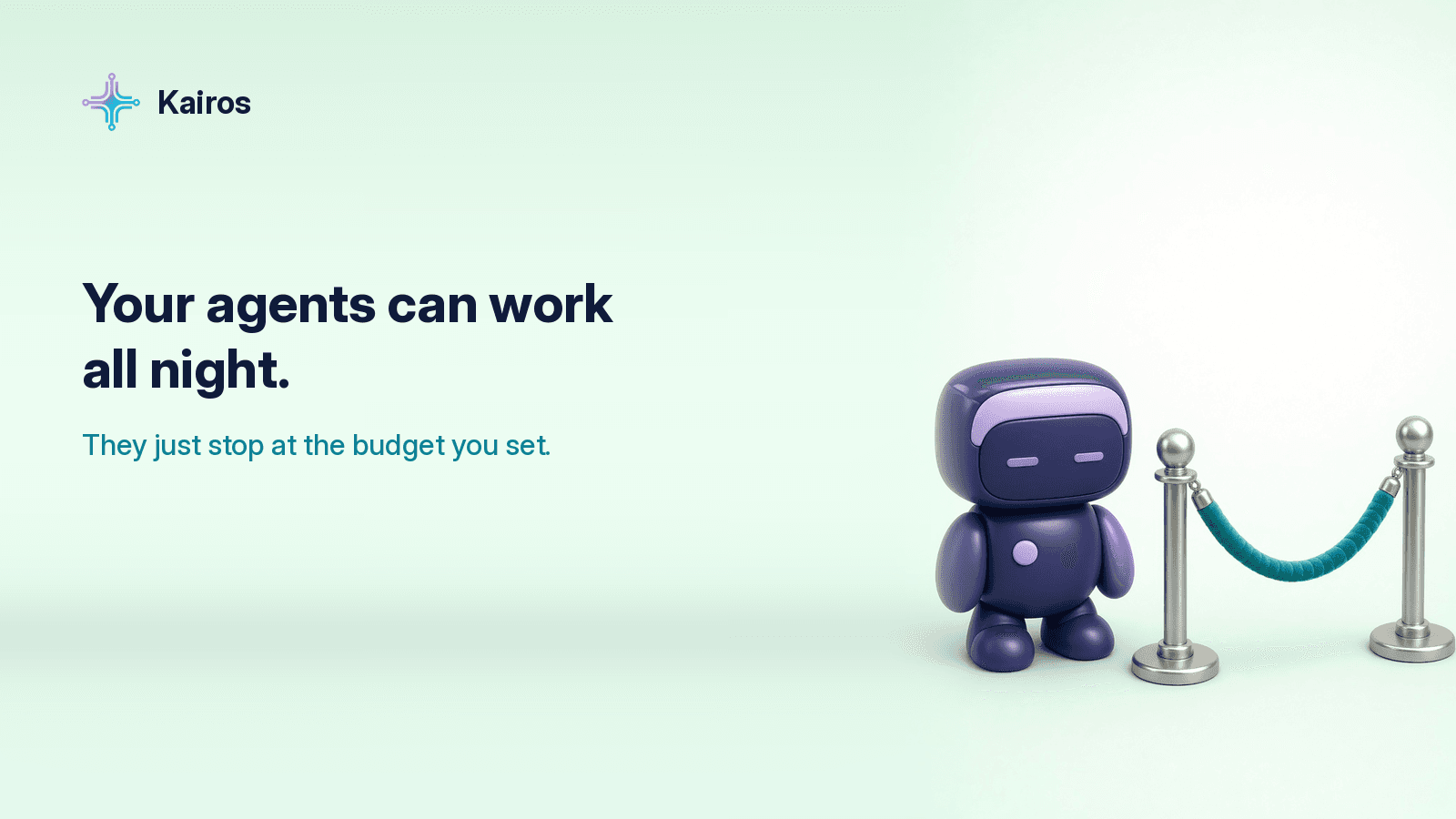
Pick the team running the most automated work, set a budget that feels comfortable, and let the agents keep working. If something loops at 3 a.m., it hits the rope and waits for morning, and so do you, well rested.
Set up your first budget at kairos-ctx.ai.