Who used AI this week, and on what?
A simple question most leaders can't answer yet. Here's why AI usage feels invisible, and what it takes to get a receipt for every request.
Try this at your next leadership meeting. Ask, out loud: who on our team used AI this week, and on what?
Watch what happens. Someone will mention the chatbot subscription. Someone else will remember that the support tool added an AI feature last quarter. An engineer will mention the coding assistant. Then the room goes quiet, because nobody actually knows.
That quiet is the problem.
AI didn't arrive as one tool
Most software arrives through a front door. Someone buys it, IT sets it up, and there's a bill and an admin panel. AI showed up differently. It came in through a dozen side doors at once: browser tabs, features inside tools you already pay for, scripts a developer wrote on a Friday, agents running in the background.
Each one is useful. None of them reports back to the same place. So when a security lead asks what data is going to which models, or a finance lead asks where the AI spend is coming from, there's no single place to look.
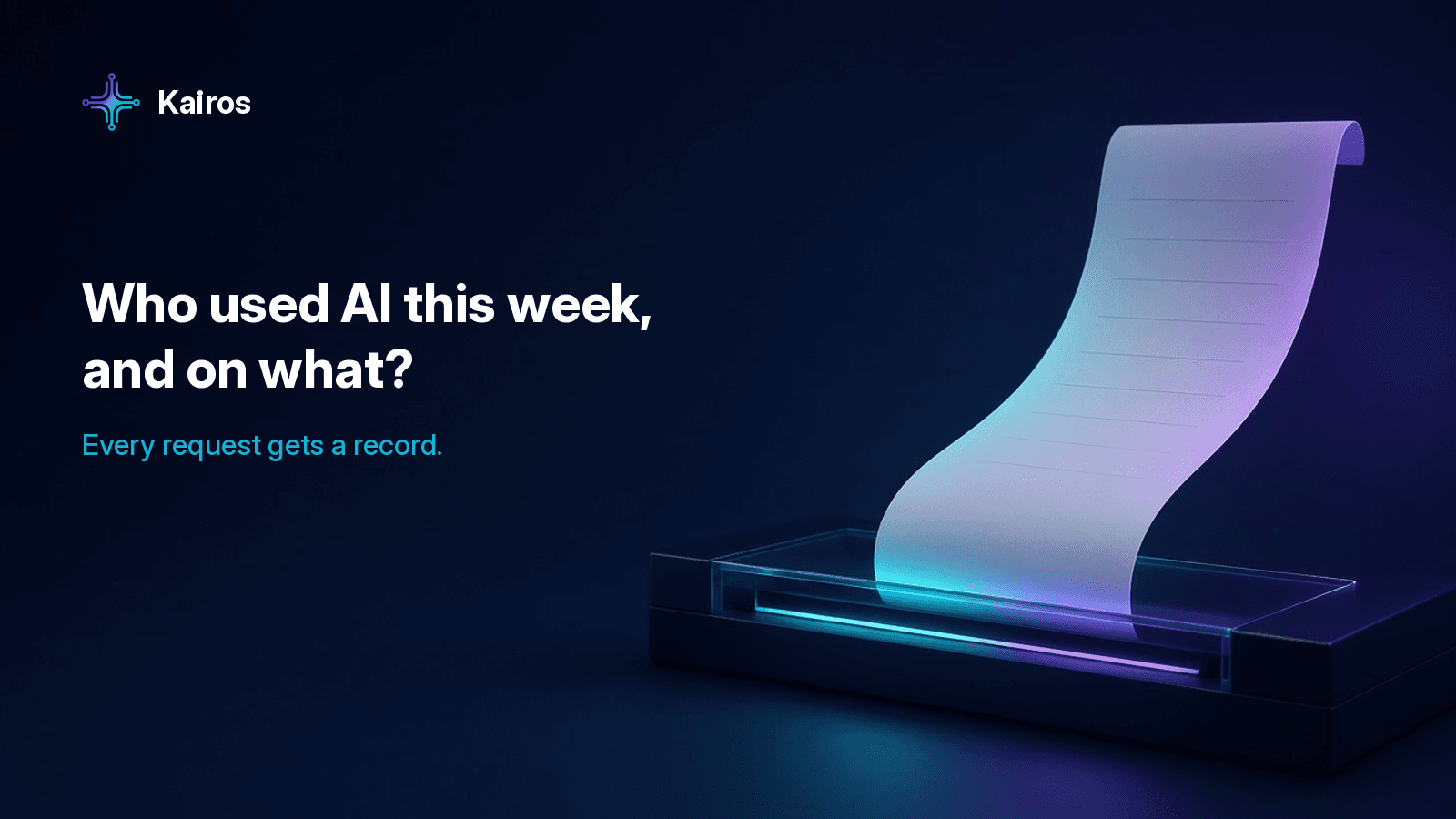
It's like running a company where every employee has a card and nobody gets receipts.
What a receipt looks like
Kairos sits between your people and the models they use. Every request goes through the same path: it's scanned for sensitive data, checked against your policies, routed to a model, and then recorded.
That last step is the receipt. For each request that goes through Kairos, there's a record of what happened. That gives leaders something concrete to look at, instead of a guess.
For a security lead, that means being able to see what kinds of data are showing up in prompts and whether your rules were applied. For a finance lead, it means seeing where AI usage is actually happening instead of piecing it together from invoices.
Visibility without slowing people down
The worst way to get visibility is to make everyone fill out a form before they use AI. People will route around it, and you'll be back to guessing.
The better way is to put the checkpoint where requests already flow. Your team keeps using the tools that help them. The rules and the records live in one place, and leaders can set policies there instead of chasing settings across every tool.
A good question to be able to answer
"Who used AI this week, and on what?" shouldn't be a hard question. It's the kind of thing a board member, an auditor, or a big customer will eventually ask. Being able to answer it calmly, with a record in hand, is a much better position than a quiet room.
Start small. Put one team's AI traffic through Kairos and see what the week looks like. You'll probably be surprised, and you'll finally have receipts.
See how it works at kairos-ctx.ai.