 KAIROS
See every use of AI.Govern every call.Spend less.
One governed path between your people, your applications and every model provider, built for the developer shipping tonight and the enterprise that cannot afford a blind spot.
Kairos is an AI control plane that sits between your people, your applications and every model provider you use. It is compatible with the OpenAI API, so changing one base URL is enough: every request, whether it comes from an IDE, an SDK, an internal service or an autonomous agent, then travels a single governed path where it can be inspected, redacted, compressed, routed, priced and recorded.
The platform closes three gaps that appear in every organization adopting AI. Visibility: Sherlock discovers the AI nobody registered and prices it by device. Fragmentation: agents, projects and automated jobs run above every provider key you have linked rather than in six disconnected tools. Control: data loss prevention, a semantic intent firewall, twenty two compliance frameworks and hard budgets apply to every call by default.
The outcome is identical for a solo builder and a regulated enterprise: a smaller provider bill, no unmonitored egress of sensitive context, and an exportable, tamper evident record of what AI actually did. Every capability described in this document is included at every price point, including the free tier. Only volume is metered, and you set that volume yourself.
 KAIROS
AI is already in use. Control is not.
Adoption ran ahead of governance in nearly every organization, and the same four gaps appear whether the buyer is one developer with a personal key or a CISO with six business units.
ChatGPT, Claude, Copilot and a dozen browser tools are already on the network, bought on personal cards and approved by nobody. Security cannot name the tools in use, finance cannot see the spend, and the first honest inventory usually arrives with an incident. Individuals hit a smaller version of the same problem: three subscriptions and an API bill that never reconcile.
Every provider brings its own key, console, SDK quirks and invoice. Context does not follow you between them, so the same prompt is rebuilt in four places and no single system knows what a piece of work cost from start to finish. Switching to a cheaper model becomes a migration project instead of a routing decision.
A prompt is an egress channel that most organizations do not monitor. Customer records, source code, contracts and credentials leave in plain text with no redaction in front and no evidence behind. Jailbreaks and prompt injection arrive at the model unopposed, and when an auditor or board asks what the AI did, there is nothing exportable to hand over.
Full conversation history is resent on every turn, so a large share of the bill buys tokens that changed no answer. Premium models handle trivial work because routing is a hard coded string. Budgets are alerts rather than limits, which means an autonomous loop is discovered the morning after it ran, not the moment it exceeded its cap.
Three steps, taken in order.
Sherlock watches the network and turns unknown AI traffic into a dollar figure by device and by provider, continuously, without reading a single payload.
Link the accounts you already pay for and every model sits side by side. Kairos matches each job to the right model, and the setups you save follow you from one project to the next.
Because all traffic uses one path, DLP, the intent firewall, 22 frameworks, compression and cost aware routing apply on every call, with a signed record of each decision.
Point Cursor, VS Code or your SDK at Kairos and carry on shipping. Routing and compression lower the provider bill from the first request, and hard caps mean an overnight agent loop cannot become a four figure surprise. The free tier includes every control.
Sherlock produces the inventory, Command Centers segment business units under RBAC and SSO, and DLP, framework enforcement and evidence packs answer the board, the auditor and the regulator from the same record. Nothing has to be reconstructed after the fact.
KAIROSDiscover unknown AI usage, and price it by device.
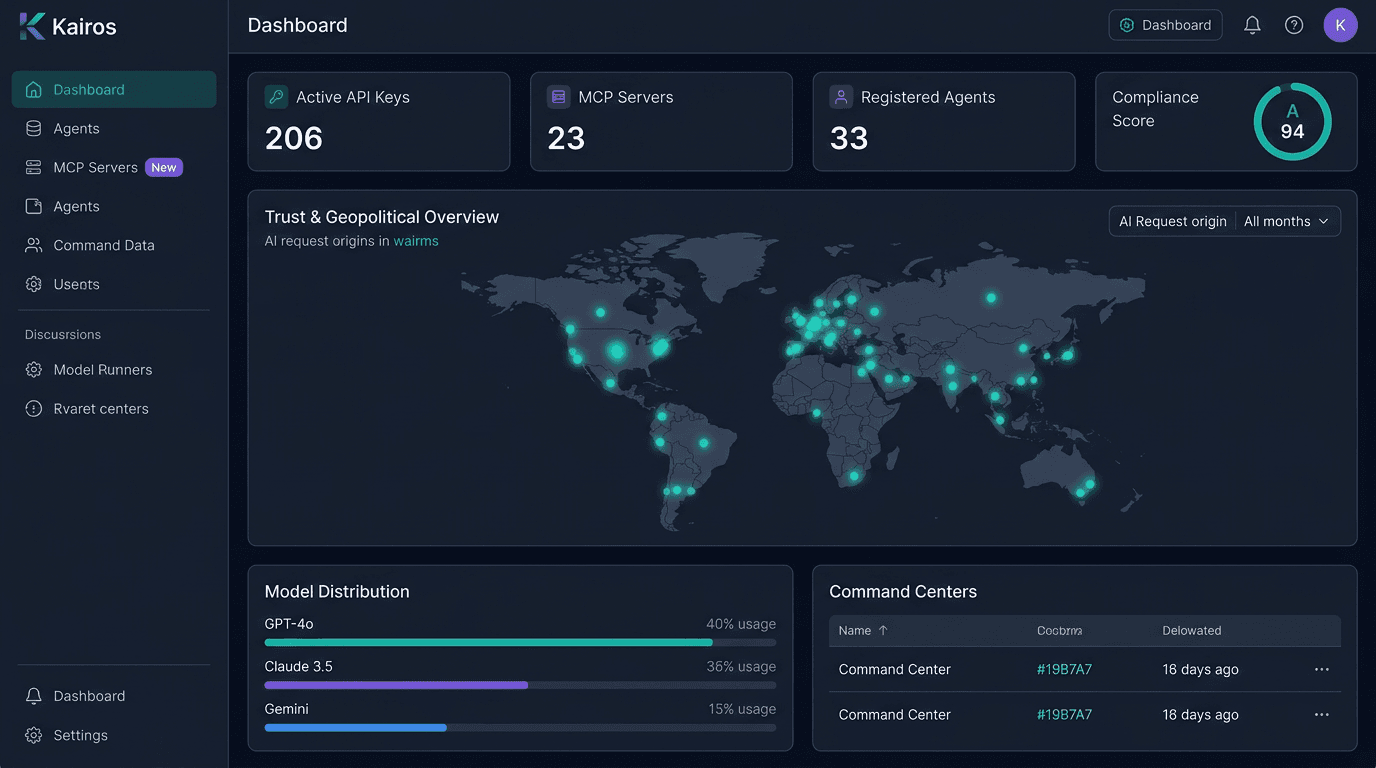
Nothing can be unified or governed until it is visible. Sherlock is a lightweight network scanner that identifies AI service traffic, attributes it to a device, and converts it into an estimated monthly cost.
 KAIROSgeo
Installation is a single command pasted from the dashboard. The scanner runs on any host that stays on and can observe egress, whether that is a router, a SPAN port, a small Linux box or a laptop in device mode. It sweeps once within minutes, then settles into continuous sixty second windows that survive reboots.
Detection reads DNS queries and the TLS Server Name Indication field only. Kairos learns that a device contacted a known AI endpoint and how much data moved; it never terminates TLS, inspects a payload or stores a prompt. Volume is modelled into token estimates and priced against published provider rates, which is how a byte count becomes the dollar figure in Figure 1.
Attribution follows IP, MAC and hostname, covering laptops, phones, servers and unattended devices alike. Scanners sharing a LAN reconcile so nothing is counted twice, and any network can be ignored outright.
KAIROSEvery provider in a single pane.
Connect the accounts you already pay for and stop treating ChatGPT, Claude, Gemini and your editor as separate worlds. Every model you have access to is at your fingertips in one place.
KAIROSWorking from one pane changes how model choice feels. Rather than deciding which subscription to open, you describe the work and Kairos matches it to the right model for the job, sending routine drafting to inexpensive models and saving the expensive reasoning models for requests that need them. It happens on every call, so the saving is automatic.
Models also become setups you keep. Configure your favorites for the work you do most, a quick one for drafting, a careful one for contract review, a specialist for code, each with its own guardrails and spending limit. Drop the same setup into a new project and it arrives configured, so nobody rebuilds a prompt or rediscovers which model was best.
KAIROSThat one screen is where a single pane pays off. Instead of four invoices and three consoles at month end, the whole picture is already assembled, team by team.
KAIROSEvery run is governed. Every call can cost less.
Governance and savings are a by product of the architecture. Once traffic crosses one plane, redaction, compliance, threat filtering, compression and budget enforcement all happen in the same pass.
Data loss prevention runs before the provider, not after. More than 152 categories of personal and sensitive data, including names, national identifiers, medical record numbers, dates of birth, payment details, credentials and API keys, are detected and replaced in the outbound request. What reaches the model is a redacted document; what reaches your audit log is tamper evident proof of exactly which fields were stripped.
Redaction is deliberately surgical. Regulated meaning is preserved while identity is removed, so the model still reasons about a high risk diabetes record and returns clinically useful guidance without ever receiving a patient name. Twenty two frameworks, including the EU AI Act, NIST AI RMF, OWASP LLM Top 10, ISO 42001, HIPAA, GDPR, CMMC Level 2 and 3, FedRAMP aligned controls and named mandates such as the Colorado AI Act, are evaluated per request rather than sampled after the fact, and organizations can add their own.
The intent firewall handles adversarial input. Jailbreaks, prompt injection, roleplay exploits and attempts to extract credentials or personal data are classified by meaning as well as by pattern, then blocked, masked, warned on or logged according to your policy. Repeat offenders can be quarantined automatically by source, category, severity and rolling window, and high stakes requests can be routed to a human reviewer before any model sees them, with reviewer corrections exportable as JSONL training data.
Cost control shares the same pass. Context compression removes at least a quarter of each payload through summarization, pruning and isolation without degrading answer quality, and can be bypassed when a workload demands verbatim context. Routing weighs cost, sending trivial work to inexpensive models and reserving premium capacity for requests that need it. Budgets are enforced rather than announced: when a key, agent or Command Center reaches its cap, the request is refused.
KAIROSOne platform, no feature walls. Only volume is metered.
Free accounts, trials and the largest deployments run the identical product. The inventory below is what ships with every plan; controls can be enabled or disabled per key and are reviewed on a ninety day cadence.
Passive network scanners price unknown ChatGPT, Claude and Copilot traffic by device using metadata only.
Shadow spend is reported beside governed spend so security and finance work from one figure.
Continuous sixty second windows, scanner heartbeats, same LAN merge, optional Pi-hole or AdGuard DNS ingest.
Device lists as TXT, CSV or JSON for firewall, NAC and SIEM workflows.
OpenAI, Anthropic, Gemini, Copilot, Mistral, Perplexity, xAI and DeepSeek endpoints, refreshed as they change.
One base URL and one scoped key for 100+ models. Streaming, tool use and function calling unchanged.
OpenAI, Anthropic, Google, DeepSeek, Mistral, Cohere, Groq and xAI linked once and shared across the workspace.
Governed chat, persistent project context, and goal driven jobs with cost, time and iteration stop rules.
Zero trust tool proxying with scoped allowlists and metering, plus a full CLI for chat, agents and job runs.
Spend, savings, request volume, compliance score and unknown AI in a single dashboard rather than five tools.
152+ types stripped before the model, with tamper evident proof attached to each call.
EU AI Act, NIST AI RMF, OWASP LLM Top 10, ISO 42001, CMMC L2/L3, FedRAMP aligned, C2PA and custom mandates.
Block, warn, mask or log jailbreaks, injection and extraction attempts by meaning, not just pattern.
Automatic holds on repeat offenders. High stakes requests routed to reviewers before the model.
SHA-256 chained decisions exportable as JSON or PDF evidence packs for boards and authorizing officials.
Summarization, pruning and isolation cut at least a quarter of each payload without degrading answer quality.
KEYWORD, REGEX, INTENT, TASK_TYPE and ALWAYS rules with fallbacks, or model: "auto" for cheapest capable.
Caps by key, agent or Command Center that block the request at the limit rather than raising an alert.
Projected monthly spend, alert thresholds, per model breakdowns, compression savings and latency distribution.
Compare models on live traffic before committing a routing rule across the fleet.
10,000+ adversarial simulations, jailbreak suites, golden set regression and cost projection before release.
Human corrections export as JSONL fine tuning data so models learn your doctrine.
Agents configured conversationally: model, guardrails, tools and caps assembled from plain language.
Hierarchical workspaces with SSO and SAML, feature toggles, geographic constraints and budgets per unit.
SIEM export to Splunk or Datadog, IP allowlisting on every key, API access to the audit trail.
NIST 800-53 control mapping, CMMC Level 2 and 3 evidence, FedRAMP aligned documentation.
KAIROSSet your own scale. Start today.
Kairos charges for the tokens it governs, never for the features you are allowed to use. There is no seat count, no enterprise tier hiding the security controls, and nothing to negotiate.
Sherlock on one network with two scanners and 100,000 governed tokens each month. Every platform capability is switched on, including agents, jobs, DLP, compliance and MCP.
Unlimited Sherlock networks and 250,000 tokens with full enterprise access. When the trial ends the account moves to the free tier rather than locking you out.
Move a slider to the monthly volume you expect and the price follows. Change it whenever you like. No quote, no procurement cycle, no conversation with a salesperson.
Pricing is a slider rather than a negotiation. Choose the monthly token volume you expect, watch the price update, and change it whenever your usage changes. The effective rate improves automatically as volume grows, so scale is rewarded without anyone asking you to sign a longer contract first. Paying annually takes a further twenty percent off.
Forecasting is what keeps the number predictable. Usage and Cost tracks spend as the period progresses and projects where it will finish, so a busy month is visible on day ten rather than in the invoice. Set a warning threshold, a hard cap, or both, at the level of an API key, an agent or a whole Command Center.
Platform cost is also only one side of the ledger: because compression removes at least a quarter of every payload while routing steers work to the cheapest capable model, the provider invoice underneath usually falls by more than Kairos costs.
Three ways in, value proven in minutes
Copy one command from the dashboard. Device mode covers a single host; --network covers the whole LAN from a machine that stays on.
Swap the base URL and supply a scoped key. Everything else in your code stays as it is. Or drive it from the CLI with npm i -g @kairos/cli && kairos chat.
A fully populated sandbox at app.kairos-ctx.ai/demo covering agents, jobs, governance and cost reporting.
Start free at app.kairos-ctx.ai/sign-up · Talk to us: [email protected]